So it turns out that people who are born on Christmas day are a lot like the proverbial London Bus. Before this week I did not know a single one, and then suddenly I met 3 in as many days (plus someone else who was born at 2 minutes to midnight on Christmas eve). Two of the three were also twins, which is even more bizarre.
Aside from the obvious reason I'm not sure why so few people seem to be born on the 25th of December, it's 1 day in 365 (unless you're born on a leap year - and incidentally I'm yet to meet anyone born on the 29th of February) so maybe I've just been unlucky.
There's also that weird fact that according to probability you only need 23 people in a room for 50% chance that 2 of them will share a birthday, and approximately 70 people for a 100% chance. I only have seven cousins but I share a birthday with one of them.
For a while facebook used to have a page where you could see all of your friends in birthday order. At the time I knew approximately 400 people on facebook but they only covered about 220 days, with September the most popular month to be born in and February the least. By carrying it on for a while I was able to tick off another 50 days, but only now could I put a mark (or three) next to December 25th!

Sunday, 25 October 2015

Tuesday, 20 October 2015
the five people you meet in heaven: review
The five people you meet in Heaven, written by Mitch Albom and published in 2003, now often makes lists of books you aught to read (and features on my page 100 books) and along with it's interesting premise I thought I would give it a go.
The story is of an old man (Eddie) who, on the event of his death, reaches Heaven (or a Heaven invented by Albom for this book) and there meets five people who affected his life in some way and help him to understand the meaning or purpose of it all.
With this in mind I began reading but was initially disappointed, partly because Albom didn't introduce the story in the way I was expecting, or the way I would have written it, and partly because I think he over explains things a bit too much, rather than letting the story do the telling. He also seemed to be struggling to understand the Heaven he had invented, with vague references to God (who doesn't appear) and confusing settings. Slowly this does iron out and the story becomes clearer and although it is fairly obvious which way the book is heading there is a nice ending that I didn't quite predict. Albom is also brave in so openly offering five 'lessons' to Eddie, which other authors have, in my opinion, sometimes struggled with (E. Nesbit, Five Children and It) and occasionally succeeded wonderfully (Harper Lee, To Kill a Mockingbird). Personally I found the lessons unclear, although the ending helped to clarify them a little.
The book is not long (under 200 pages) and is easily readable and overall I found it enjoyable and a little moving. I'm not convinced it would make my top 100 books, but as a simple story it's worth a read.
Monday, 12 October 2015
Helvellyn: Take 2
Today I finally reached the summit of Helvellyn, on my second attempt of the year. This time I approached from the north-west up an never ending staircase of stone steps, rising above Thirlmere and into the cloud.


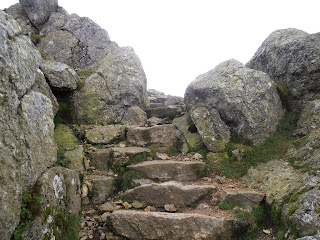


If you hadn't guessed it was blowing a gale, but at least now I could see where the sheer drops were.
After this the views improved dramatically on all sides, although the cloud hung around until I was lake-side once more, when the sun turned the Lake District golden. Consequently I have come to the decision that while Helvellyn is a monster of a mountain, and not to be taken lightly, it is also one of my favourites.


After waiting for the cloud to dissipate until my legs got cold I eventually trudged onward into the mist. The top levelled out and through the cloud I made out Red Tarn to the east.

Ten seconds later this was the view:

If you hadn't guessed it was blowing a gale, but at least now I could see where the sheer drops were.
After this the views improved dramatically on all sides, although the cloud hung around until I was lake-side once more, when the sun turned the Lake District golden. Consequently I have come to the decision that while Helvellyn is a monster of a mountain, and not to be taken lightly, it is also one of my favourites.


Friday, 9 October 2015
PGL Update
It's been a busy few weeks and I realised I haven't written about PGL recently, so here's an update.
I am now qualified in almost all of the ropes sessions at Winmarleigh, including Abseiling, Zip Wire, and all of the 'Ground Up' sessions (climbing), of which there are many. This means I do fewer ground sessions, in which you generally get to know the group better, but does mean I get to really challenge the kids. The most rewarding moments are when children, who are truly scared, achieve something great by stepping out of their comfort zone. Some only get half way up a ladder, and some come down in tears, but telling them how amazingly they've done to push beyond what they thought they could do seems to increasingly make me start to well up too.
During the past week I have been group leading, working with a group during their stay, but I have also run a few sessions. This morning I instructed a session on 'Wobbly Bars', the final activity for eleven of the kids from my group. Most of them managed fine, but one girl had to be persuaded to climb beyond the 10th step, up to the lowest bar. Eventually she got her feet onto the bar and managed to shuffle far enough away from the ladder to be let down. She was in tears but had gone further than in any other climbing session during the week. Later the whole group (I was co-looking after 80 kids in total) were asked who had achieved something during the week that they didn't think they could have done. Almost all of them put their hands up but I noticed the girl from earlier didn't and she looked disappointed. I managed to catch her eye and told her with a look and a point of my finger that she had. She got the message and raised her hand minutely.
Playing games, singing till my voice is broken and dancing wildly at a disco are all great fun, but it is these wonderful moments that make working for PGL so brilliant.

Monday, 28 September 2015
The Science of Fine Tuning
Did you know that if the mass of Jupiter was greater than it is then Earth's orbit would become unstable, meaning our planet would drift either closer to, or further from, the sun? Earth is approximately 93 million miles from the sun and a change of more than a million miles or so would render life on Earth impossible. Equally if the mass of Jupiter was lesser than it is, Earth would receive far more asteroid and comet collisions, too many to sustain human life. The same things are also true is Jupiter was closer or further away from us.
Life on Earth is ridiculously unlikely when you look at all of the requirements. The study of such requirements is known as the Science of Fine Tuning. There are a lot of requirements.
The Earth tilts on its axis at 23.5 degrees, which prevents the planet from becoming too hot or too cold. One or two degrees different and there would be no life here.
The reason for the tilt is because of our moon, which is the perfect size and sits at the perfect distance. This also means we get the wonder of eclipses, when the moon lines up with the Earth and the Sun for dramatic effects.
Other necessities for life include oxygen and nitrogen levels and the ratio between them; the thickness of the Earth's crust; the length of one rotation of the planet; the surface gravity; the amount of seismic and volcanic activity (yes these things are vital for life); the quantity of water and the quantity of salt in the oceans (3.4% - which is equivalent the quantity of salt in our blood streams), quantities of chlorine in our atmosphere and iron in the soil, and many more things I cannot comprehend (such as the quantity of iodocarbon-emitting marine organisms).
If such things do not make you wonder about life on Earth, how it exists and how precious it is, I don't know what will.

Thursday, 17 September 2015
From the Private's diary
Dawn had not yet broken as HMS Inconstant
arrived in Rosyth Harbour at 6 am, March 5th, 1918. It had been a
night without event, which by then was not so unusual, especially for the light
cruisers, although the cold March winds across the North Sea, and off the East
coast of Scotland
The day was grey and plain, without rain, but the fifteenth century ruins ofRosyth
Castle
Having docked, the crew of HMS Inconstant set about oiling and watering the ship down. This took time, but was a well practised routine and meant little to the men and it only gained brief mentions in the diaries and letters of those who liked to write. Private Ligertwood was one of those, jotting down short notes whenever he could find a spare moment. He also liked to draw and sketch and having some free time he learned how to draw a pig with his eyes shut, and proved his success by pencilling one into his pocket diary.
By the following morning the weather was even more unsettled, and very cold. The wind was causing problems, and the sporadic showers left everyone irritable and short tempered. The lack of orders was not helping either and although the harbour was busy, crowded with vessels and shouting, their was a general feeling of boredom amongst the men. On deck some went through rigorous fitness exercises, while down below others played cards, chess, chequers, or wrote letters, poems, diaries, anything to keep their minds occupied.
Fred Ligertwood liked his writing, and particularly liked words. He enjoyed spelling them out, and putting them together and it was always a disappointment he didn’t have time to write more; another curse of the war. He was a young man, typical of those in the forces. He’d joined up in 1914, illegally, as he’d only been 14 at the time (instead of the required 15). Like many others, he had lied his way into the Royal Marines. Four years on he was still there, and no less happy or thrilled by the boyish feeling of being part of the War.
He’d played his part, quite literally, when he’d blown the Bugle to begin the first attack in the Battle of Jutland, possibly the biggest Naval battle of the war to date. It had lasted almost two days from May 31st to June 1st, 1916, off the coast ofDenmark .
The Germans intended to lure out a portion of the British navy and defeat it,
but as per usual with all well made plans, particularly in war, things were
never going to be that simple. By the end of the battle many ships and even
more lives had been lost, on both sides, but the British remained in command of
the sea and therefore saw it as a victory for them. HMS Inconstant had returned
unscathed and for her crew the war had gone on.
At the entrance to the harbour HMS Champion, who had also been atJutland as the
leader of the 13th Destroyer Flotilla, was on the lookout for
submarines, while most other ships were under ‘short notice’. At 1pm they were
put under 1 hour’s notice. The white ensign was flying at the masthead of
Inconstant and they were secured for sea, but they didn’t get ‘under weigh’ until
5.30pm. HMS Courageous led the way out of the harbour, the other ships filing
in behind, like people from a stadium after a match has finished. For these men,
though, the nervous excitement was only just beginning. Most of them knew
nothing of their mission, but Private Ligertwood noted in his diary – “Weather
expected to be very rough – buzz about convoy being sunk in North
Sea .”
In the end he never discovered if this rumour was true because the weather was beyond rough. So much so that at 11.50pm all ships were ordered to return to base. This alone took over 5 hours and they eventually entered the harbour under the early morning light. Private Ligertwood felt a little the worse for wear and submitted himself to the sick list. A quick injection later and he returned to update his diary. “Blinking sore.”
The day was grey and plain, without rain, but the fifteenth century ruins of
Having docked, the crew of HMS Inconstant set about oiling and watering the ship down. This took time, but was a well practised routine and meant little to the men and it only gained brief mentions in the diaries and letters of those who liked to write. Private Ligertwood was one of those, jotting down short notes whenever he could find a spare moment. He also liked to draw and sketch and having some free time he learned how to draw a pig with his eyes shut, and proved his success by pencilling one into his pocket diary.
By the following morning the weather was even more unsettled, and very cold. The wind was causing problems, and the sporadic showers left everyone irritable and short tempered. The lack of orders was not helping either and although the harbour was busy, crowded with vessels and shouting, their was a general feeling of boredom amongst the men. On deck some went through rigorous fitness exercises, while down below others played cards, chess, chequers, or wrote letters, poems, diaries, anything to keep their minds occupied.
Fred Ligertwood liked his writing, and particularly liked words. He enjoyed spelling them out, and putting them together and it was always a disappointment he didn’t have time to write more; another curse of the war. He was a young man, typical of those in the forces. He’d joined up in 1914, illegally, as he’d only been 14 at the time (instead of the required 15). Like many others, he had lied his way into the Royal Marines. Four years on he was still there, and no less happy or thrilled by the boyish feeling of being part of the War.
He’d played his part, quite literally, when he’d blown the Bugle to begin the first attack in the Battle of Jutland, possibly the biggest Naval battle of the war to date. It had lasted almost two days from May 31st to June 1st, 1916, off the coast of
At the entrance to the harbour HMS Champion, who had also been at
In the end he never discovered if this rumour was true because the weather was beyond rough. So much so that at 11.50pm all ships were ordered to return to base. This alone took over 5 hours and they eventually entered the harbour under the early morning light. Private Ligertwood felt a little the worse for wear and submitted himself to the sick list. A quick injection later and he returned to update his diary. “Blinking sore.”
Saturday, 12 September 2015
Sports Fans
As much as football crowds in the UK have a bad reputation both for being crude and occasionally violent, they do also contain a seed of that brilliant British humour. Only a football crowd would sing "Is there a fire drill?" while the losing opposition fans head for the exits before the conclusion of a match.
Cricket fans, however, have to top them for being able to create a great atmosphere with fewer members in attendance. Although only at cricket matches do you get supporters of the winning team leaving before the conclusion because they've got to get home for their tea.
Rugby fans, predictably, are the most hardy of supporters, being the ones most happy to continue watching in an open stadium in a downpour, although a match is only 80 minutes long.
The best all round supporters, however, are probably those who follow individual sports such as golf and tennis because they are most appreciative of great play regardless of who is successful, and that is something I wish would transfer to all sports grounds, because I think it is something that is in all fans.
Subscribe to:
Posts (Atom)